Come and meditate and relax for a while….
Nourishment for Your Soul
words, pictures and music
to inspire, soothe and delight
Resourceful Intelligence Transforming Lives


Right now, we’re very much heads down getting ReSource ready for press, so I’m deeply engrossed in putting all the personal and business development articles together, honing with images and fine tuning.
Like most people, that can mean I don’t take time to look up from the screen and take in what’s around me to see what’s happening (following on from yesterday’s post, even what’s changing, evolving or transforming…!) We can tend to take things (and people) for granted, and not notice how much they contribute to making our lives a more joyful, beautiful or easy place to be.
Last week the view from my study window was filled with green, albeit there were clusters of tight buds on the rhododendron bush which is now so large it fills the foreground. This week with the sunshine it’s burst into full flower, transformed, even, and because I know it will be relatively short-lived, I made a point of going out and taking some photos to capture what’s right under my nose that’s giving me such a lovely outlook.
My thinking was that it might rain, that it was windy, and the flowers might therefore get battered and bruised more quickly, and I’d miss the moments of pristine beauty. So it was ‘carpe diem’ and off I went, results shared below.
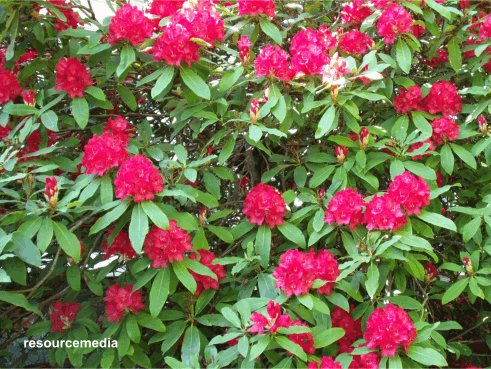
Brilliant May flowers....

a stunning backdrop
Take just a minute to look around you, to think and consider –
what’s or who’s under your nose that you’re not fully appreciating.
What can you capture from today as it is, in this moment,
and express your gratitude for the present of the present?


The recent post about ‘the robin who thinks he’s a humming bird’ talks about the rate of evolution speeding up, and the need to be highly adaptable in a fast paced world.
In conversation last week with a friend about personal growth and development, he mentioned that he prefers the word ‘evolution’ to that of ‘change’. His rationale is that ‘change’ creates fear in people. As creatures of habit, most people prefer things to stay the same and worry that change must mean something uncomfortable. It prompted me to think about the terms we use and to ask if change and evolution are the same thing, and when and where the words are best applied.
There are some things that definitely require to be changed not evolved. For example, I definitely change my light bulbs, they do not evolve. (The type of bulbs I use may have evolved over the years, from tungsten to energy saving, but the act of replacing them when spent is a definite change). Neither do I evolve my bed linen, my vacuum cleaner bags nor the filters in my water jug. These, though are all inanimate objects. And people are, of course, different….
The way I perform these tasks may well have changed over time – or even evolved – so perhaps the differentiation comes from here. Behaviours, skills, strategies, beliefs, opinions, systems can evolve. The human body can and does evolve – with better nutrition in the developed world, we’re now much taller, and with the advent of the contraceptive pill, women’s body shapes have changed – or evolved. To say nothing of the way the human brain has evolved over thousand of years into its current tripartite embodiment. According to neuroscience, it’s also apparently evolving in response to the amount of time we spend online especially with regard to gaming and social media. Human thinking can also evolve, we can learn to use our inner resources more effectively, we gain by education, and our way of life has changed dramatically since the beginning of life on earth – discoveries, experiments and inventions have brought radical changes and alterations to how we conduct the daily business of living as human beings on our planet.
Now, if we are encouraging people to change – can we more easily ask them to evolve, can we evolve by volition and action, or does evolution take place naturally, almost unconsciously, in response to outside conditions but with no deliberate intervention?
I’d like to believe we can choose to evolve ourselves voluntarily, courageously, at the growing edge of experience, thought and living.

Is transformation perhaps the more encouraging word to use? Transformation has a certain magic about it, a positive sense of something happening which offers a better, happier outcome. Or is that simply my interpretation? Does transformation contain an inbuilt element of wisdom and improvement, which change does not? There can be subtle changes, but somehow a subtle transformation does not sit well, meaning-wise, for me. Change can be for better or worse, but in my neurology, transformation is equated with betterment.
For example, I would say ‘the witch changed the prince into a frog’ – and ‘the fairy godmother transformed the pumpkin into a splendid carriage’. Then, I suppose, if the prince wanted to become a frog for some reason, he’d consider it an improvement….And now the ‘Shrek’ movie comes to mind when the princess chooses life as an ogre because of her love for Shrek.
Now I’m onto Pygmalion, whose dedicated thought and intention transformed a marble statue into a living woman for him to love…..maybe he changed his thoughts, evolved his way of being… and thus transformed and even transmuted a substance which then transformed his life….a process to realise and manifest what he wanted most?

I could get really deep into the linguistics here – so many nuances and shades of meaning, but I will stop for now.
Change, evolve, transform – all have their place, and it’s fascinating to continue exploring their meaning in our lives.
teenage expression
“When I was 18 my father was completely ignorant, but by the time I was 25,
it was amazing how much he’d learnt.”
Too True!
BONUS TIP 6:
Laugh. Find some common ground in humour, satire, irony – maybe through a TV programme or film. It may make you throw your hands up in horror, but ‘The Simpsons’ has some prize moments of sheer comic dis-functionality in which most of us can see a little something of ourselves, if we’re really honest. After all it’s been around for 20 years and now has its own stamp collection…..

happy, confident teens
But dads (and mums) be warned – telling bad ‘dad jokes‘ (and it seems that all dad jokes are bad jokes, even if they’re good…..) creates embarrassed looks, groans of ‘Ohhh Daaad’, rolling eyes and shrugged shoulders – you have to decide if you want to experience that. On the other hand, if you don’t do generic ‘dad jokes’, maybe your teen will miss out on being able to share horror stories with their mates…..And sharing the experience is part of growing up.
As parents, that’s what we’re there for – silent witness, loud supporter, soft shoulder or sharp wit – you’ll need all of that and more along the way. Is it worth it? Completely – it’s one of life’s richest treasures.
© Christine Miller

Picture the scene – it’s late spring, and outside my window, hanging on the end of a cane attached to the roof of the conservatory is a bird feeder. It’s that type of solid pudding or cake, meant for small birds such a great tits and blue tits, who have been feeding there since winter.
The rather Heath Robinson means of suspension is somewhat complex in order to deter the ever present voracious squirrels who were so desperate to reach it they even attempted to scale the slippery glazing bars surrounding the windows. Lacking crampons or suitably formed claws, they failed – and their surprised look as they slid down the outside of the window was highly amusing. Observing those squirrels as they circled, pondered, made vain attempts and kept on trying and devising new routes was a valuable lesson in persistence.
It also reminded me of this wonderful TV programme some years ago when even the most complicated methods of keeping squirrels away from food failed, and the acrobatic audacity of the creatures was portrayed with hilariously entertaining results.
We’ve added deterrents to keep off starlings and blackbirds, and this little food supply is nourishing several families of birds. The tits themselves are no mean acrobats; their aeronautic feats are really quite breathtaking. They fly in at breakneck speed, stop suddenly – just short of splattering themselves onto the glass; at the same time they turn themselves upside down and hang onto the feeder with their feet, whilst staying ever alert to potential threats from predators – truly impressive stuff.
We have had some wonderful entertainment and inspiration watching the to-ing and fro-ing, and pondered on the sheer physical effort required to nurture a nest of chicks to fledgling status.
Recently, there have been territorial wars and thrilling examples of adaptability and determination. Enter our common garden friend, the Robin. Ever present whenever we are out in the garden raking leaves or turning over earth, they grab grubs in their inimitable opportunistic way, bold, alert and happy to sing for their supper.
The robins observed that the tits were very messy eaters – they left behind lots of scraps, probably at least half of what they peck off drops onto the ground beneath the feeder. Initially, the robins simply cleaned up the scraps on the floor. Then they became dissatisfied and wanted to control the food supply.
Slight problem – their spindly legs and larger body weight do not naturally lend themselves to performing the feats of inversion and gripping at which the tits are so expert. A fly-past peck doesn’t do the trick of dislodging the food.
What to do?
New approach – the robins attack the tits whenever they alight on the feeder – but only after they have filled their beaks – causing the tits to disgorge the food onto the floor and enabling the wily robins to clean up the spoils.
Next, the robins decide that they are spending too much time waiting for the tits to turn up and serve dinner.
What to do now?
It appears that robins have very strong wings. So they ingeniously decide to adopt the hovering method. Expending huge amounts of energy, they flap their wings, humming-bird fashion, at great speed, maintaining themselves in position to be able to devour the food directly from source. It is a remarkable sight, the wings a blur as they flap furiously – and they return time after time, fiercely defending the feeder, so the tits are having to dive in at the moments when the robins are back at the nest feeding their young. Other birds have got wise – pigeons, blackbirds and starlings congregate underneath and pick up the scraps, and the odd crazy blackbird seems to want to emulate the robin, and also pretends to be a humming bird.
Now the scenario outside my window is more peaceful again, and the Robin has reverted to waiting on the ground whilst the tits congregate on the feeder and scatter the food. The fledged blue tits accompany their parents, and though perfectly capable of feeding themselves, still willingly accept the thrusting beak inserting food into their throats.
It’s said evolution takes a long time, many generations; in this rapidly-moving world I’m beginning to think that adaptation is a much faster-paced affair, with enterprising creatures observing effective behaviours in other species, and adopting them quickly.
The Robin
He gained control of the food supply for his family, in that intense period of requiring huge quantities to feed the growing chicks.
Hopefully we have begun a sustainable cycle which will see many families of birds return each year to rear their young, and provide us with ongoing lessons in flexibility and adaptation.
We can all learn a great deal from observing how nature adapts to ensure nurture.
© Christine Miller
A poem taken from Secret Garden of the Soul

Getting the #Brexit ducks in a row – or not? A Facebook friend asked how we want our #Brexit today – boiled, fried, roasted … my immediate thoughts were that it is to me, half-baked, par-boiled, and conversely, paradoxically, burnt and battered, leaving many of us bewildered, and anxious, whichever side of the divide we stand. […]
© 2010–2026 Christine Miller | Resource | Design by Porto Publishing | Log in