Christine Miller

business and personal success strategist, resourceful entrepreneur, author, soul poet, speaker, psychologist

The camera never lies…

camels

Or does it?

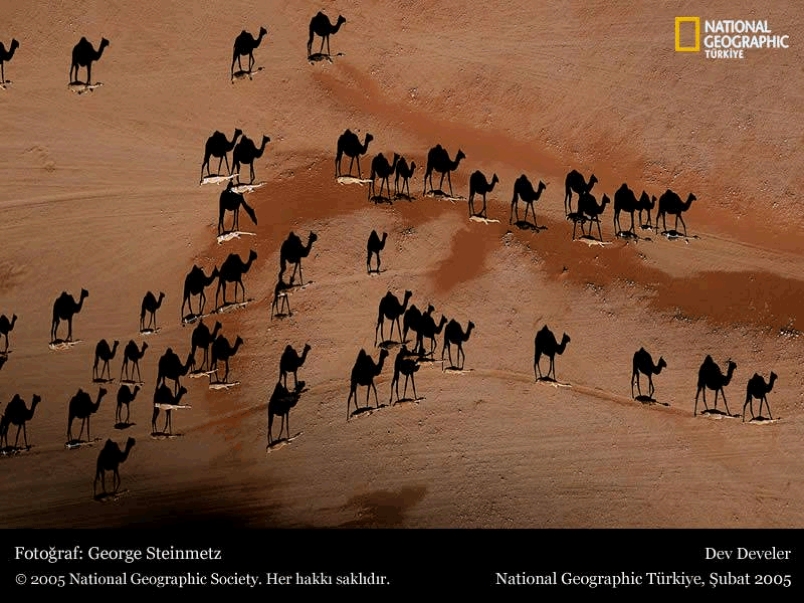
This picture was taken directly above the camels in the desert at sunset.

It is considered one of the best pictures of its year.

The camels are the whitish flecks.
The black camel shapes are the shadows!

(with thanks to Emmanuel Elliott for sending this through)

So I’m prompted here to wonder about how we see and interpret things, and the meaning we make from them – the shadows in this photograph are bigger, bolder, capture the attention and look as if they represent reality, as if they are the camels. Then we discover that the real camels are the tiny spots of light, overshadowed by their shadows. It’s like an optical illusion, and reminds me of The Allegory of the Cave in Plato’s best-known work, The Republic.

How often are we afraid of what is really only a shadow, a trick of the light?  Something we avoid or don’t do because we mis-perceive a monster lurking, a large object in the way, when the reality is a spot of light?

How often are we seduced by the outer, louder, more obvious in our lives, and therefore miss the subtle, the sensitive, that which requires us to go deeper and reflect, or take an uncommon perspective and see value and beauty in the less familiar?  So much depends on the way we look at things – can we walk around our own thoughts, our biases and long-held opinions and beliefs, and find greater value than we have previously dreamt?

Like the optical illusion books popular a few years ago, which reveal a hidden image when you view them in a certain way, our world can reward us with fresh ideas and possibilities if we take the time to shift our position, reconsider our point of view and see things differently.

See what you can find in this picture:

Find the hidden message

Find the hidden message

Votes from a Small Island

Three Contenders

Three Contenders

The Public Debates

Three men stand together, facing not only unrelenting lights and cameras, but also an uncompromising (yet apparently unconvinced) electorate on national television, and a select studio audience primed with unknown awkward questions.  Each man is hopeful, yet desperate; passionate in his way, yet somehow desolate; committed to leading a nation and its people to better times, wanting and needing to be trusted. They are reminiscent in some ways of Moses leading his people to the Promised Land; and if chosen, face a task of similar proportions, given Great Britain’s current financial predicament.

So can we determine who has the power not only to part the metaphorical Red Sea of troubles facing whichever party may win the election, but also has the courage and conviction to lead us to the beckoning shores of safe recovery?

Societal Symbols

The suits are well-cut, the grooming immaculate – the outer face of British political leadership perhaps differentiated only by the colour of a tie and the type of knot with which it is carefully arranged…and I can’t help feeling those ties in some way stifle the true being that is striving to bring his message  to the British people.  Do these silky symbols of belonging to a certain sector of society actually cut off the connection between their heads and their hearts? Are they really feeling what the people want – or are they too ‘prepped’ and primped, too slickly coached and chivvied into being what their advisors and publicity teams think the public wants?

Would we have preferred to see the debates as a ‘loosen the tie, roll up the sleeves and let’s get to work and tackle the challenges we’re facing’ honest to goodness, humble attempt to offer solutions, in contrast to the interminable point scoring put-downs that, frankly, have left me bored and irritated that not one of them came across  as being a totally worthy contender?  Although the polls give it to Cameron for last night’s debate, there’s still a very mixed response out there.

Understanding Change

I wanted David Cameron to be what I’ve seen and heard him do in the past. I was at the CBI conference in 2006 when he delivered a powerful speech that won over the 1,000-strong audience of top business leaders. He had a bold, clear message that won hearts and minds – and the leadership of his party.  In 2008 at Leaders in London he again delivered a moving speech. Articulate, humorous, flowing naturally and comfortable in his skin – he was truly convincing. Now of course, there’s more at stake – there’s more at stake for all of us – it’s a time when a clear bold plan and a big heart can win the day.

David, are you listening? At Leaders in London you said – “don’t try and be something that you’re not”. Look at these words again – “politics is about understanding what’s happening in your country… politicians don’t win just because they’ve got the best slogans… winning in politics is about understanding the forces of change and responding to that problem.” Do you still hold that as true?

Pause, Reflect, Listen

This week we saw the rawness of Gordon Brown as he (inadvertently) publicly expressed his private sense of discomfiture at Gillian Duffy’s comments and questions – that was an honest, visceral , if shocking response – and in the true sense of the word ‘bigot’, (Spectator)  he may have had a point. It was careless, it seemed hypocritical, it displayed lack of understanding – it was an unfortunate insight into the concerns that constant media pressure and polls place on leaders. The most important thing in that moment was not the voter, nor the woman, but the irritation of being faced with a sensitive issue – immigration – and how the encounter might influence the overall outcome.  Maybe Gillian Duffy’s comments, outside the arena of political correctness, expressed a side of public opinion that is not politically or publicly acceptable, but is it pervasive in private? Is it pervasive in Lancashire, a Labour heartland and my own home county. A Rochdale pensioner’s concern about the extra stress placed on already scarce resources by increases in population might have hit a raw nerve, and may even be representative of floating voter’s opinions – who knows?  Brown was flustered and discomfited, and that’s not statesmanlike behaviour.

It was a big diference from the time in late 2008 when I heard and saw him speak to an audience  of committed innovative social entrepreneurs and activists at the Chain Reaction event, pledging help and support for new business  – again, now there’s more at stake, events have unfolded which have undermined those positive commitments and the excitement of his young ambassadors telling their stories.

Gordon needs to learn to pause, reflect, listen – carefully – and not react – Gordon, are you listening?

Crucial Floating Voters

As for Nick Clegg, his policies and views might well represent a new way, a different outcome, ‘real’ change – but to me it seems like there is game playing, and the boyish charm which is undoubtedly appealing perhaps doesn’t present the mature gravitas that needs to be there for those crucial floating voters to be really convinced. I’ve more experience of hearing Vince Cable  who is the epitome of informed enthusiasm and passion for a fairer economy and society – tempered by wisdom and his being ‘seasoned’.

Statesmanlike Qualities

I don’t really want a ‘politician’ as the country’s leader; I want a Statesman.  Someone with dignity, composure, common sense and intelligence – and the intellectual and compassionate, emotional capacity to understand how important it is to stay connected to their people’s needs and wants.

As voters, we’re all small islands who can come together to make change happen – who is going to convince us that their qualities and vision, and their practical abilities to take action, will get us safely to the distant yet achievable shore of sustainable growth and mutual benefit?

What will be the outcome for votes from a Small Island, votes for a Small Island next week?

It’s in our hands…so what kind of leader do we deserve?

(acknowledgement to Bill Bryson and his brilliant ‘Notes from a Small Island‘)

How to Increase Your Business Success with Mind Maps – Tony Buzan

Tony Buzan, author of 100 best-selling books

Tony Buzan, Inventor of Mind Maps and author of 100 best-selling books

Chris Griffiths CEO of Think Buzan

Chris Griffiths CEO of Think Buzan

Mind Maps for Business

We’ve used Mind Maps at ReSource since the very beginning – our first edition contained a hand drawn map of the contents, and Tony Buzan has been a regular contributor covering areas from business to creativity and poetry.  In a brief preliminary interview for an upcoming  ReSource feature, I asked Mind Maps® inventor Tony Buzan about his latest book, ‘Mind Maps for Business’, written with Chris Griffiths,   CEO of Think Buzan.

“Tony, what’s different about this book ‘Mind Maps for Business’? What differentiates it from ‘Mind Maps at Work’, for example?”

“There is a comprehensive difference – ‘Mind Maps at Work’ was a play on the word ‘work’ – it was a way of showing Mind Maps working, and how they are effective in people’s lives in a broad range of contexts, not just at work. It also served as an introductory text for people in any working situation, not only in business, which is completely different.  In a way, it was a gentle preamble to Mind Maps for Business, and it certainly generated demand for the business book. People had read Mind Maps at Work, and other books, and this led to many requests for a book totally dedicated to the business world.

“The Mind Maps for Business Book has copious illustrations, there is full colour throughout, and there are inspiring stories and case studies  gathered from around the world from major players using Mind Maps. Some examples are Nicky Oppenheimer, Chairman of de Beers diamond mines in South Africa, who describes Mind Maps as an ‘indispensable tool’, which he used to steer his senior management team during a time of refocusing to capture the essence of the organisation – where it had been and where it was heading.”

Mind Maps for Business

Mind Maps for Business

Packed with Stories and Pictures

It’s true the book is packed with accounts of success in using Mind Maps for business from many different people.  Stephen Lundin, author of the 5 million copy best selling  FISH! says:

‘Mind Mapping uses the brain in the way it was designed, saves time, improves results and is fun. How can any business person be without this powerful tool?’

Masanori Kanda is known as one of the most influential entrepreneurs in Japan today. He was named the top marketer in the November issue of GQ Japan (2006) and speaking of the radical reorganisation of his company to respond to change, says: ‘Mind mapping can play a pivotal role in the process of developing a sustainable organisation that is adaptable to rapid changes today. With open and transparent cross-functional communications in all directions, the organisation grows to become more fair, resilient and effective.’

The introduction in 2006 of iMindMap, the Buzan technology for computer generated Mind Maps, developed in conjunction with Chris Griffiths, has also given rise to many more business applications. Major corporations, including Boeing, have used the methodology to envision and manage the multiple stages of complex projects from conception to delivery.

Says Mike Stanley, of the Boeing Corporation, USA:
“The use of Mind Mapping is an integral part of my Quality Improvement Project at Boeing. This has provided savings of over $10 million for my organisation.”

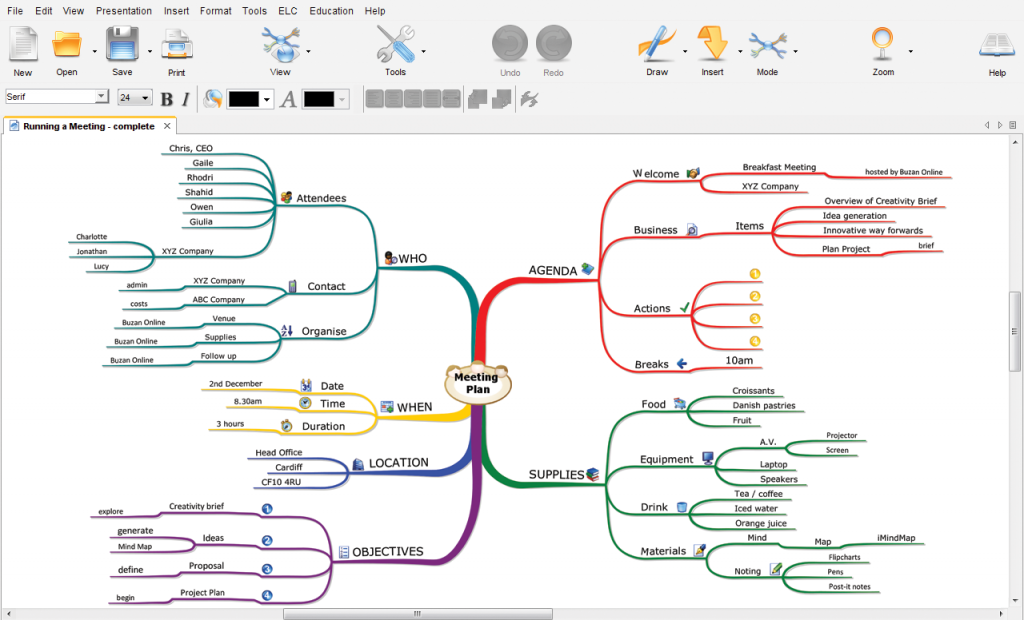
iMindMap Running a Meeting example

iMindMap Running a Meeting example

Timely and Comprehensive Guide

Now is the time when this book from Tony and Chris is most needed – we live in a fiercely competitive world, where global choice is greater than ever before, and customers and clients have broader options and market intelligence readily (and instantly!) available through the Internet. Agility in spotting trends, organising and managing multiple ideas and strategies, and smart implementation are key to success, something to which the use of Mind Maps is eminently well-suited.  They can help you sell, negotiate, plan, brainstorm, manage – and do so more effectively, saving you time and money.

Several people I’ve interviewed recently for ReSource (including top US business coach Marshall Goldsmith and New York Times bestselling author and consultant Marcus Buckingham) have suggested that ‘we’re all entrepreneurs now’. One unexpected current example in the UK is within the public sector, in tertiary education, where funding cuts are changing the landscape dramatically. Situations are arising where employees, some of whom have been in their jobs for ten or fifteen years, are now obliged to re-apply for their existing posts – and are consequently required to ‘sell’ themselves again as the best possible candidate for the job. This requires the skill of knowing how to best position yourself, not something most public sector employees have previously had to consider. The ability to identify and promote your key assets, talents and expertise as benefits to your organisation thus become critical to successful job retention, and Mind Mapping can also assist with this.

Transforming Business and Life

In this age of the changing world of work, when everyone, whether employed or running their own business, needs to adopt a more intelligently entrepreneurial mindset, ‘Mind Maps for Business’ helps fill a need for ways to develop clarity of thinking and effective methods to manage complexity and diversity. Mind Maps have been proven to achieve this –  over many years, across innumerable disciplines, and ‘Mind Maps for Business’ is an essential addition to the library of books we return to time and again for practical applications and guidance on being better in the business world – especially in the business of living productively and well.

You can get the book easily now at Amazon & WHSmith

Look out for a full article in the next edition of ReSource

Doing Well by Doing Good

Social Enterprise, sustainability,  and triple bottom line business have been a major focus for ReSource over recent years; we believe that personal and business growth and development go hand in hand – and we’ve been inspired and motivated by Muhammud Yunus and his Grameen Bank example, an enterprise which won Yunus the Nobel Peace Prize; by Lord Andrew Mawson who has been described as ‘Britain’s Social Entrepreneur’ – his groundbreaking Bromley-by-Bow Centre in one of London’s most deprived areas has transformed many lives and been a beacon for better ways of creating cohesive communities; and dedicated people such as Carole Spiers, Ida Horner, Getrude Matshe, who give their time, resources and expertise to projects around the world aimed at helping people to help themselves.

I recently heard Kevin Spacey talk about his projects ‘Old Vic New Voices’ at the Old Vic Theatre to help less privileged young people develop and grow through theatre training workshops and experiences -he described it as ‘sending the lift back down’ to bring up those not yet in a position to fulfill their potential and use their gifts and talents fully. It’s true that these days many people want a ‘hand up’ rather than a ‘hand out’ – and social businesses which offer an opportunity for gainful and worthy employment whilst creating social benefits are a proven way to achieve this.

Later today I’m attending a round table on ‘How to Change Lives with Good Business”, with Sally Reynolds of Social Firms UK giving a heads-up on her perspective as CEO of an organisation championing firms providing opportunities  to find sustainable employment  in the open labour market for severely disadvantaged people. My involvement with setting up our own humanitarian education and development organisation The ReSource Foundation as a social enterprise, and my recent partnership with a major network of Social Entrepreneurs makes this a highly relevant and topical event – I’ll be reporting with more information soon!

Here’s a brief video giving more information about Social Firms:

Happy Chinese New Year

Tiger photographed on safari at Ranthambore, India, October 2008

Tiger photographed on safari at Ranthambore, India

We at ReSource were thrilled to be able to visit India, and one of the highlights was our tour of Rajasthan: an amazing place of contrasts (like the whole of India!) where we were privileged to be able to go on a tiger safari. The entire three weeks we spent in India was a source of inspiration and joy – the sub continent has an uncanny ability to draw you out and encourage your personal growth!

About Ranthambore National Park

Once we knew we were going to India in Autumn 2008, we started to look for the most enriching experiences there – and something that really stood out as a must-do, must-see was to go on a tiger safari.


These big cats seen in their natural environment held great fascination, and we found ourselves heading for Ranthambore National Park in Rajasthan, a protected area, one of the few places in India where tigers are still regularly seen, even in the daytime, and are breeding.

Formerly a hunting preserve for the Maharaja of Jaipur, Ranthambore covers an area of 392 sq. km. and is nestled between the Aravali and Vindhya mountain ranges. This deciduous forest was once a part of the magnificent jungles of Central India. The rugged terrain, hills and open valleys with lakes and pools makes it a really romantic and picturesque place to be.


It seems we arrived at just the right time, and that we even had good ‘karma’, according to the locals, as we were able to see several tigers in the course of our three day safari. The excitement of being so close to these amazing creatures was almost indescribable, a real privilege – in fact, quite an emotional experience for all concerned, and something I would recommend wholeheartedly if you have the chance to visit.

www.ranthamborenationalpark.com

Return to top of page

© 2010–2025 Christine Miller | Resource | Design by Porto Publishing | Log in